
Replacement or Addition? Following the money through West Virginia’s new power-plant buildout

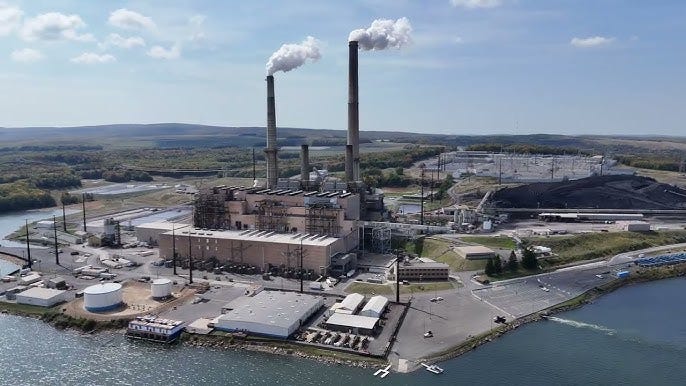
Three major power announcements arrived within days of one another, each exposing a different side of the same shift in West Virginia’s electricity economy. The public record shows why regulators should examine not only whether the new plants are needed, but whether customers could be left paying for the new capacity, the old capacity, the transmission built around them and the economic losses that follow when coal generation is displaced.
I do not believe in coincidences. When three announcements land within days of one another and each concerns the future value of a large West Virginia power plant, the timing deserves more than three separate news stories. Dominion Energy announced plans for a 2.6-gigawatt natural-gas plant beside its existing Mt. Storm coal station. American Electric Power agreed to buy the 710-megawatt Longview coal plant and the permits for a possible 1.2-gigawatt gas plant at the same Maidsville complex. Omnis Pleasants, the company that bought the Pleasants Power Station with a plan to produce hydrogen and graphite from coal, entered Chapter 11 bankruptcy after the promised conversion failed to reach commercial operation.
The timing is the hook, but the money is the story. One announcement concerns regulated utility construction, one concerns a competitive-market acquisition, and one concerns a failed merchant venture. Add FirstEnergy’s pending proposal for a 1.2-gigawatt gas plant beside Fort Martin, and the same question appears across all four transactions: who will own the risk when enormous new generating plants are built beside older coal units that are still operating, still carrying costs on utility books and still being described as essential? The companies are not all pursuing the same strategy, but they are responding to the same tightening power market, the same rush of projected data-center demand and the same new value placed on sites with fuel, land and high-voltage transmission.
The official answer at Fort Martin and Mt. Storm is that the gas plants are additions, not replacements. That answer may be true when construction begins. It may remain true for several years after the gas units enter service. It does not settle what happens over the full life of the investments. A new gas plant can operate beside an old coal plant for a time, reduce the coal plant’s use as market conditions change, and eventually become the basis for retiring the coal unit. If the projects are approved under traditional utility regulation, customers can be required to pay for the new plant while continuing to pay for the old one. If the coal plant then closes before all of its approved costs have been recovered, customers can also be asked to pay the remaining balance and the cost of demolition, ash management and site cleanup.
Recognizing a pattern is not the same as alleging a conspiracy. No public document reviewed for this article proves that FirstEnergy, Dominion, AEP or Omnis coordinated these events, or that FirstEnergy or Dominion deliberately intends to strand its coal plants after winning approval for new gas capacity. The financial structure nevertheless makes that sequence possible, and statements already in the record make it necessary for regulators to investigate before approving billions of dollars in construction. At Fort Martin, FirstEnergy’s chief executive previously described new gas generation as the replacement for the company’s West Virginia coal fleet. At Mt. Storm, Dominion has said the gas project will have no impact on the coal station, even though public regulatory testimony reports that the company’s own planning assumptions showed the coal plant’s use falling to almost nothing in the early 2030s. Those are not minor differences in wording. They go directly to the expected use of the plants, the useful lives assigned to them and the costs customers may be asked to bear.
Fort Martin: from “replacement” to “alongside”
FirstEnergy’s Mon Power and Potomac Edison subsidiaries filed in February for approval to build a 1,200-megawatt combined-cycle gas plant on 35 acres beside the Fort Martin Power Station in Monongalia County. The filing puts the gas project at approximately $2.5 billion and adds $200 million for 70 megawatts of solar at three other sites. The gas plant is scheduled to enter service at the end of 2031 if the West Virginia Public Service Commission approves it and construction stays on schedule.
Fort Martin is not an empty industrial site. It is a 1,098-megawatt, two-unit coal station that began operating in 1967 and 1968. It has received hundreds of millions of dollars in environmental controls and remains a substantial producer. Recent federal data summarized by GridInfo show about 5.6 million megawatt-hours of annual generation, equal to an approximate capacity factor of 58 percent. A capacity factor is simply the amount a plant actually generated compared with what it could have generated by running at full output all year. A 58 percent figure does not describe a plant waiting for retirement. It describes a plant that is still doing a large amount of work.
FirstEnergy’s current public position is that the new gas station will be added to its existing fleet. The company’s announcement says its resource plan calls for continued operation of Fort Martin and the larger Harrison Power Station, a 1,984-megawatt coal plant in Harrison County. Harrison has recently generated about 11.1 million megawatt-hours a year, an approximate capacity factor of 64 percent. Together the two coal stations supply far more energy than the proposed Maidsville gas plant could produce unless it ran at unusually high levels.
The earlier record is different. In February 2025, FirstEnergy President and Chief Executive Brian Tierney told investors that the company expected to build three to four gigawatts of combined-cycle gas capacity to replace Fort Martin and Harrison, which were then described as scheduled to close between 2035 and 2040. He estimated that program would cost between $4 billion and $6 billion. A year later, the first 1.2 gigawatts of that gas program appeared in a filing as generation to be built beside Fort Martin while the coal plants continued operating.
The change may reflect rising electricity demand, higher prices in PJM’s capacity market, new state policy favoring additional generation, or a revised view of the coal plants’ value. It may also reflect the political and regulatory advantage of describing the gas plant as an addition. A proposal framed as a direct coal replacement would immediately require the commission to confront a retirement date, the unrecovered balance on Fort Martin, the effect on coal employment and the cleanup bill. An addition can be considered first as a response to load growth and reliability, leaving those coal questions for later.
The distinction matters because FirstEnergy has asked for unusually strong protection on the gas project. Its filing proposes a surcharge that would begin recovering financing costs while the plant is still being developed and built. Once the plant enters service, the company would seek to move the costs into base rates. It also requests authority to recover prudently incurred costs if the gas project or asset is later canceled, abandoned or stranded for reasons beyond the company’s control. Fuel costs would be recovered through the annual fuel proceeding.
In plain terms, the request would allow customers to begin paying carrying costs before the plant produces electricity, then pay depreciation, debt costs, a return to shareholders, taxes, operating expenses and fuel after it opens. Mon Power’s stated capital structure is half debt and half equity, and its allowed return on equity is 9.8 percent. On a $2.5 billion gas plant, the first-year allowed return on the equity portion alone would be about $122.5 million before the balance begins declining through depreciation. That figure is not the company’s profit and does not include debt or operating costs. It shows the scale of the financial interest created by putting the plant into regulated rate base.
Using the filed cost, the stated financing structure and a 30- to 35-year recovery period, a reasonable planning estimate is that customers could pay roughly $5.5 billion to $6.7 billion in capital-related charges over the gas plant’s life. That range includes repayment of the original investment, financing costs, the allowed return and associated taxes. It excludes fuel and most operating costs, which could add many billions more but would also be offset by the value of the electricity produced and by avoided purchases from the market.
The other side of the account is Fort Martin. Public filings do not provide one current, complete figure for the coal plant’s remaining book balance, retirement costs and coal-ash obligations. Based on its assumed retirement period, its recent capital history and comparable plant liabilities, a reasonable estimate is $350 million to $800 million if the plant closes in the early-to-middle 2030s. The lower end assumes continued depreciation and a relatively contained cleanup. The upper end assumes a larger remaining balance, additional work before retirement, and higher demolition or ash costs.
That puts potential capital-related customer recovery on both sides of the Fort Martin transaction at roughly $5.9 billion to $7.5 billion. The midpoint is about $6.5 billion. This does not mean FirstEnergy would receive a $6.5 billion profit, and it does not mean every dollar would be unreasonable. It means the commission is being asked to approve a structure under which customers may finance a new plant while still supporting the old plant and could later be asked to finish paying for the old plant after it is no longer generating.
The overlap would not be theoretical. FirstEnergy’s existing depreciation assumptions contemplate Fort Martin operating until about 2035, while the gas plant is scheduled for late 2031. If both dates hold, customers could spend roughly four years paying the new plant’s full revenue requirement while also paying Fort Martin’s depreciation, maintenance, fuel and environmental costs. During construction, they could pay the gas surcharge while the coal plant remains in rates. Whether that overlap is prudent depends on how much electricity is truly needed, how both plants are expected to run, and which customers are causing the demand increase.
Mt. Storm: a larger proposal and a sharper contradiction
The same question is more consequential at Mt. Storm because the proposed gas plant is more than twice the size of the Maidsville project. Dominion Energy proposes to build 2.6 gigawatts of combined-cycle gas generation beside its existing 1.6-gigawatt coal station in Grant County. The company has filed for an air permit, and public announcements place the planned opening in 2034. The project remains subject to permits, transmission review and approval by the Virginia State Corporation Commission, because the electricity would primarily serve Dominion customers in Virginia.
Dominion’s public statement is categorical. A company spokesman said the gas plant would not replace the coal plant and “will not have any impact” on it. The governor’s announcement likewise said the existing coal station would remain operational for years. Yet Mt. Storm’s recent regulatory record presents a much less certain future.
In public testimony filed in Dominion’s 2025 Virginia rate case, an expert for the Sierra Club reported that Dominion projected Mt. Storm operating at an average capacity factor of about 42 percent over the following five years, then falling to an average of only 2 percent from 2030 through 2035. The same testimony said Mt. Storm had incurred net revenue losses in three of the previous five years and challenged the high future capacity-price assumptions Dominion used to support continued investment. Dominion’s longer-range resource plan reached a more favorable conclusion about the plant, in large part because it placed substantial value on reliable capacity in a tightening PJM market. The competing analyses show a plant whose future depends heavily on assumptions, not one that can be declared unaffected before the new gas plant has even completed a full regulatory review.
Recent generation data place Mt. Storm’s annual output near 4.9 million megawatt-hours, or an approximate 35 percent capacity factor. The plant is old: its three coal units entered service between 1965 and 1973. It also remains expensive to maintain. Public testimony listed $135.3 million in fixed and variable operating costs and capital spending for the 2026 rate year and $146.4 million for 2027. Those amounts include $56.7 million and $79 million in capital spending, respectively. A separate public record showed a remaining plant balance of approximately $515 million as of June 2022. Continued depreciation may reduce that balance, but new investments can increase it.
The gas project does not yet have a public cost filing comparable to FirstEnergy’s Maidsville application. Applying the current Maidsville construction cost per kilowatt to the larger Mt. Storm plant produces an estimated construction range of about $4.7 billion to $5.7 billion. That is an estimate, not a Dominion figure. It could prove low if gas turbines, labor, pipeline construction or financing costs rise, or if the site requires extensive transmission work. It could prove high if the shared site and existing infrastructure produce substantial savings.
Virginia currently authorizes Dominion an equity return of 9.8 percent. Assuming a financing mix near half equity, the initial annual return on the shareholder-financed portion of a $4.7 billion to $5.7 billion plant would be roughly $230 million to $290 million before depreciation. Over a 30- to 35-year life, total capital-related customer collections could fall in a broad range of $10.5 billion to $14 billion. Again, that is not a profit estimate. It is an estimate of the gross capital revenue requirement that would repay construction, financing, shareholder return and taxes.
Mt. Storm’s existing coal costs add another layer. The known 2022 book balance, later capital additions and eventual demolition and ash obligations support a rough coal-side exposure of $800 million to $1.3 billion if major new environmental projects are not added. Public regulatory modeling has also discussed a possible environmental compliance program approaching $1.5 billion across the three units, although Dominion said it was still evaluating its obligations and options. That figure should not be treated as an approved project. If something near that scale were built and placed in rates, however, the combined coal exposure could move well above $2 billion.
Under a no-major-upgrade case, the potential capital-related recovery for the new gas plant and the existing coal plant together is approximately $11.3 billion to $15.3 billion. If a large new coal compliance program is added, the range could approach $13 billion to $17 billion. Combined with Fort Martin, the two sites could therefore involve roughly $17 billion to $23 billion in capital-related customer collections, or approximately $19 billion to $24 billion if Mt. Storm receives the full scale of additional coal investment discussed in public modeling. The numbers are necessarily broad because Dominion has not filed a complete gas cost case and current coal balances are not fully public. Their purpose is to show the size of the decision and the need for transparent, combined modeling before approval.
Current use and proposed additions
Nameplate capacity describes how much a plant can produce under rated conditions. It does not show how much the plant actually produces over a year. The first chart compares the existing coal plants by recent capacity factor, using annual generation reported through the spring of 2026. The second converts those percentages into average utilized output and places that output beside the announced capacity at the same sites. The comparison does not predict how frequently any proposed plant will run. It shows the scale of the additions relative to the amount of existing capacity currently being used, and why the week’s separate announcements belong in one examination.
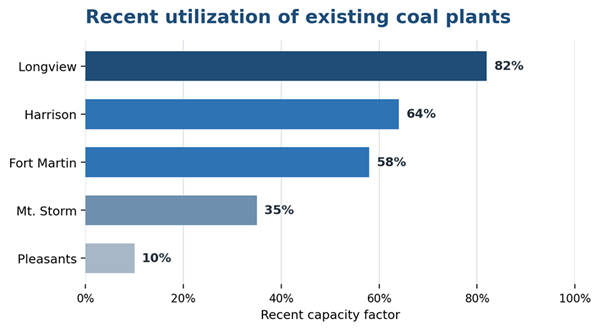
Figure 1. Approximate recent annual capacity factors, based on EIA generation data reported through spring 2026.
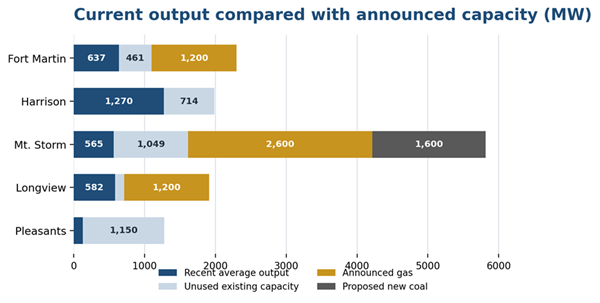
Figure 2. Existing nameplate capacity is divided between recent average output and capacity not used on average. Announced additions are nameplate megawatts, not dispatch forecasts. Longview gas is permitted but unscheduled; the TerraSpark coal project is early-stage. Clearway’s 335-megawatt wind repower is excluded because it replaces an existing wind facility.
What happens when gas and coal share the same site
Locating gas and coal plants beside one another can reduce costs. A utility may be able to share land, roads, security, water facilities, maintenance functions and high-voltage transmission. It can also operate a more flexible group of units. The gas plant can start and change output more quickly, while the coal plant can remain available for long runs, extreme weather and periods when gas supply is constrained or expensive. If demand rises as projected, both may earn substantial revenue in PJM’s energy and capacity markets.
The same arrangement can cause the plants to compete with one another. PJM generally selects plants according to the cost of producing the next megawatt-hour, subject to transmission limits and reliability needs. The construction cost of a new gas plant does not usually determine that hour-by-hour choice once the plant has been built. The relevant comparison is fuel and operating cost. An existing coal plant whose original construction has largely been paid for can dispatch more cheaply than a new gas plant when it has favorable coal contracts, inventory on site or a high regional gas price. The gas plant’s capital cost may be recovered from customers, but it does not give the plant priority in PJM’s dispatch. A new combined-cycle unit has much better fuel efficiency and can still be cheaper in hours when delivered gas is inexpensive.
This week’s Coal Currents market data illustrate the point. Northern Appalachian coal was listed at $70 a ton, equal to about $2.69 per million British thermal units, while Henry Hub gas was $2.56. Those fuel prices cannot be compared dollar for dollar because the gas plant would use substantially less fuel to produce each megawatt-hour and because Henry Hub is not the delivered price at a West Virginia turbine. At that particular hub price, a highly efficient new combined-cycle plant could have a fuel-cost advantage before pipeline charges and plant-specific operating costs. A long-term coal contract, on-site inventory, a gas-price spike or pipeline constraint could reverse the order. The defensible conclusion is not that one fuel always dispatches first. It is that existing coal can be the lower-cost energy resource even after a regulated utility has committed billions of dollars to new gas, creating the possibility that the new plant earns capital recovery and capacity revenue without running as often as its approval case implied.
This is why a gas plant described as an addition can still reduce coal generation. The system does not need to issue a formal replacement order. If the gas unit repeatedly produces at a lower marginal cost, the coal plant can run less. A lower capacity factor spreads the coal plant’s fixed costs across fewer megawatt-hours, making its electricity appear more expensive and creating the next argument for retirement. If regulators have already approved the gas plant and the remaining coal balance is later declared uneconomic or stranded, customers may be asked to absorb both decisions.
At Mt. Storm, that competition would extend beyond one gas plant and one coal plant. The federal government has awarded TerraSpark up to $18.5 million for front-end engineering, permitting and early studies for a proposed 1.6-gigawatt coal plant with carbon capture adjacent to the Mt. Storm complex. President Donald Trump highlighted the proposal as part of a federal coal initiative. The award is development money, not financing for construction, and the TerraSpark plant remains an early-stage proposal by a separate developer. It should not be counted as certain capacity.
If every announced project were completed, however, the area would contain about 5.8 gigawatts of thermal generation: Dominion’s existing 1.6 gigawatts of coal, Dominion’s proposed 2.6 gigawatts of gas and TerraSpark’s proposed 1.6 gigawatts of new coal. Clearway is also repowering the nearby Mt. Storm wind project under a long-term 335-megawatt power-purchase agreement with Microsoft. The wind farm is a separate, competitively financed project, but its output would enter the same broad regional market.
Those resources would not all run at full output simply because they share an address. They would have separate owners, separate interconnection rights and different contracts. At times they could complement one another. At other times, they would compete for energy sales and transmission space. The existing coal plant, with much of its original investment already depreciated, might be able to offer power below the price needed to justify an expensive new coal plant. The new gas plant could underbid both during periods of cheap gas. The new coal plant’s carbon-capture system could add substantial operating and capital costs even if it qualifies for federal support. All three could nevertheless collect capacity revenue for being available during scarce conditions. That combination makes a complete site-wide and regional dispatch study essential.
Capacity payments without much generation
This is the point at which PJM’s capacity market becomes central to the investigation. The energy market pays a plant when it produces electricity. The capacity market pays for a commitment to be ready in a future delivery year. A generating unit can therefore have a low annual capacity factor, sell few megawatt-hours and still receive a large capacity payment if its accredited capacity clears PJM’s auction. Low energy production is not, by itself, evidence that the capacity payment was improper.
The numbers explain the incentive. PJM’s July 2026 auction for the June 2028 through May 2029 delivery year cleared at the administratively established cap of $325 per megawatt-day of accredited capacity. At that price, every 1,000 megawatts that clear produce $118.6 million in gross annual capacity revenue if fully accredited. Thermal plants are not generally credited at 100 percent of nameplate capacity, so the table below uses an illustrative 80 percent accreditation factor. It is not a forecast for any plant, and actual payments will depend on unit-specific accreditation, the amount offered and cleared, future auction prices, ownership shares, outages and bilateral arrangements.
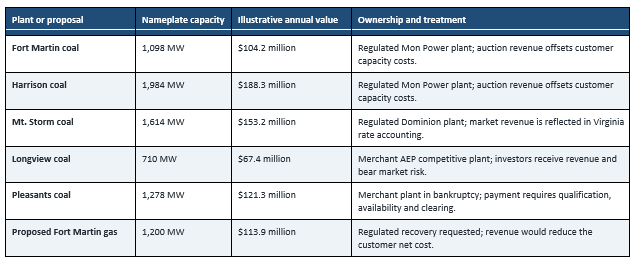

Table 1. Gross annual capacity value at $325 per accredited megawatt-day and an illustrative 80 percent accreditation factor. These are not unit-specific forecasts or net profits.
The illustration shows why keeping several plants nominally available can be financially attractive even if the grid does not need their energy most of the year. At the 80 percent assumption, the existing coal plants listed here represent roughly $634 million a year in gross capacity value at the 2028–29 price. The four announced or permitted thermal additions represent another $626 million. At Mt. Storm alone, the existing coal station, the proposed gas plant and the proposed TerraSpark coal plant could represent roughly $552 million a year at the same assumption if all were built, accredited, offered and cleared. The market may never support all of that capacity at the same price, but the scale is too large to omit from any explanation of why owners want to preserve old units while developing new ones.
That does not mean the owners can simply park a plant, refuse to run it and collect money for nothing. PJM Manual 18 requires generation with a capacity commitment to offer into the day-ahead energy market. Capacity resources are subject to summer and winter capability testing, and they face non-performance charges when PJM declares a performance-assessment interval and a resource falls short of its obligation. Beginning with the 2025–26 delivery year, the annual stop-loss on those charges can reach one and one-half times the applicable capacity-auction clearing price multiplied by the committed capacity. A unit that cannot remain available also risks a lower future accreditation and can be required to obtain replacement capacity.
The opening is narrower but still important. A unit can submit a legitimate cost-based energy offer, remain available and not be selected because other plants are cheaper in ordinary hours. If few emergency intervals occur, it may collect the full year’s capacity revenue after producing very little energy. The Independent Market Monitor has also warned that the present performance formula can require less output than the plant’s full installed capability. It used the example of a unit with an 80 percent accreditation factor whose expected performance can amount to only 64 percent of installed capacity, and recommended aligning the obligation more closely with the full capability covered by the energy-market must-offer rule. That criticism does not prove abuse at any West Virginia plant, but it shows that the rules do not completely answer the concern.
Ownership determines who benefits. Longview is being acquired by AEP’s competitive business, so capacity revenue belongs to the merchant owner and helps cover the plant’s private fixed costs; shareholders and lenders also bear the loss if the plant fails to clear or perform. Pleasants is likewise a merchant plant, and its ability to earn capacity revenue depends on maintaining PJM qualification and physical availability through bankruptcy. Preserving that eligibility can add value for a buyer, but the bankruptcy record reviewed for this article does not establish that capacity payments are the company’s sole or primary operating strategy.
Fort Martin and Harrison are different because Mon Power bids their capacity into PJM while also buying capacity for Mon Power and Potomac Edison’s West Virginia load. In the ratemaking structure described in prior West Virginia commission testimony, plant capacity revenue is netted against the companies’ capacity charges, so customers receive the benefit rather than allowing the utility to keep the auction proceeds as an unregulated windfall. Dominion’s regulated market revenues are also accounted for in Virginia rates. The remaining concern is still substantial: a regulated utility can earn its approved return on a plant in rate base while the plant’s capacity revenue makes it appear valuable even if it produces little energy, and customers can remain responsible for fuel-security spending, maintenance, environmental work and the unrecovered balance. Regulators should therefore require capacity revenue, energy revenue, annual fixed cost and actual generation to be reported together for each unit. A capacity check by itself can make a lightly used plant look profitable while concealing what customers pay to keep it available.
Longview shows the difference between utility and market risk
AEP’s agreement to acquire Longview offers the clearest comparison with the regulated proposals. Longview is a modern, supercritical coal plant that entered service in 2011. It has nevertheless gone through bankruptcy twice, a reminder that a technically strong plant can fail financially when its owners depend on wholesale-market revenue and carry too much debt.
Longview has recently generated about 5.1 million megawatt-hours a year. Based on its 710-megawatt summer capability, that is an approximate capacity factor of 82 percent, far above the recent figures at Fort Martin, Mt. Storm or Pleasants. AEP also agreed to acquire the Mountain State Clean Energy development site, which includes important permits for a future 1.2-gigawatt combined-cycle gas plant. No construction schedule has been announced.
AEP has said Longview will be owned and operated by its competitive generation business and that the transaction will not directly affect Appalachian Power customers. That distinction is critical. A competitive owner must recover its purchase price and future investment from market revenue, capacity payments or private contracts. If the economics fail, shareholders and lenders bear the loss. A regulated utility, by contrast, can seek commission approval to recover prudent costs from captive customers and earn a return on the approved investment.
The reported runner-up in the Longview sale was a major data-center developer that considered using the plant’s entire output for an artificial-intelligence facility, potentially removing the generation from ordinary grid supply. Published accounts describe the bidder as a household-name developer, but they do not establish that the power would have been sent to Northern Virginia. The more defensible conclusion is that the bidder saw value in controlling reliable generation at or near the data-center site. AEP’s willingness to outbid that buyer shows how much competitive value it now assigns to a high-performing coal plant and a permitted gas expansion in a capacity-short market.
Longview therefore complicates any simple claim that existing coal cannot compete with new gas. Its recent performance suggests that a modern coal unit with strong operations can run at a high rate even while gas plants expand. It also demonstrates the discipline that comes with merchant ownership. AEP’s competitive subsidiary is placing its capital at risk. West Virginia regulators should require an equally rigorous market test before placing Fort Martin’s gas project in customer rates, and Virginia regulators should do the same at Mt. Storm.
Pleasants: When the market rejects the promise
Pleasants presents the other side of merchant risk. The 1,278-megawatt coal station was purchased in 2023 after its prior owners prepared it for closure. Omnis promoted a plan to use coal in a process that would produce hydrogen and graphite, with the hydrogen eventually used at the plant. The company said the project would return the station to full operation. Instead, the plant remained largely idle and Omnis Pleasants filed for Chapter 11 in late July with more than $70 million in listed debt, including more than $50 million owed on a low-interest loan from the West Virginia Economic Development Authority.
Recent generation data show about 1.1 million megawatt-hours a year, an approximate capacity factor of only 10 percent. The plant has continued limited market and reliability activity, but nothing close to the production needed to support the original public claims. Bankruptcy filings and public statements from current management describe disputes with former management and allege misuse of funds. Those allegations are contested and have not been finally decided by a court. The established facts are narrower: the hydrogen and graphite plan did not reach commercial operation on schedule, the company cannot presently meet its obligations outside bankruptcy, and a sale process is being considered.
Basic maintenance and plant operations are expected to continue during the bankruptcy. At the July 29 first-day hearing, the bankruptcy court gave Omnis Pleasants interim authority to use cash and other assets pledged to lenders so the station could remain in operation while management pursues a sale. The court also authorized payments and arrangements covering employee wages, utilities, taxes, insurance, critical vendors and energy-market hedging. Those orders allow the company to meet its obligations to PJM, preserve the generating units and continue energy trading or limited generation when the plant is available and the market supports it.
That does not mean the 1,278-megawatt station will return to normal output during Chapter 11. Its recent utilization remains near 10 percent, and maintenance is likely to be concentrated on safety, environmental compliance, reliability and preserving the plant’s value for a buyer. The company still depends on cash, lender cooperation and further court approval. Operations could be reduced if liquidity deteriorates, and a future sale or restructuring plan could lead to expanded generation, continued low use, mothballing, conversion or closure. The present order keeps the plant functioning; it does not settle its long-term operating future.
The bankruptcy does not automatically return Pleasants to ETEM or to the owners who controlled the property before the 2023 transaction. The debtor, Omnis Pleasants LLC, is the same limited-liability company that was formerly known as ETEM Remediation Two LLC. Its current bankruptcy petition identifies Quantum Pleasants LLC as its sole equity owner. The plant remains property of the bankruptcy estate, subject to court supervision, creditor claims, liens and any valid contracts. A former owner could regain control by purchasing the asset, enforcing a proven contractual right or prevailing in litigation, but no public filing reviewed for this article establishes an automatic reversion.
The realistic options are a court-supervised sale to another merchant generator, a utility, a data-center developer or an industrial buyer; continued coal operation under a new capital structure; mothballing; conversion or repowering if a credible developer can finance it; or closure and remediation. A behind-the-meter data center could give the plant a dedicated customer, but the plant would still need major investment and a workable fuel, environmental and reliability plan. A regulated utility purchase would shift the question to ratepayers and would require a new prudence review. The hydrogen proposal should not be revived on promises alone. Any successor pursuing it would need to demonstrate the technology at commercial scale, identify firm customers, disclose the full capital requirement and show that the project can meet its obligations without another unsecured public subsidy.
Pleasants is not currently a traditional rate-based utility plant. Its failure therefore falls primarily on its owners, lenders and creditors rather than automatically on electric customers. West Virginia taxpayers are nevertheless exposed through the state development loan. The episode shows why ownership structure matters. Longview’s buyer is accepting market risk because it believes the plant has value. Pleasants is in court because its market plan did not produce the revenue it promised. Fort Martin and Mt. Storm would place much more of the investment risk on customers if regulators approve full cost recovery.
What West Virginia loses when coal generation falls
The public discussion of new gas plants concentrates on construction jobs because the number is large and immediate. FirstEnergy now describes about 2,000 construction jobs at the Fort Martin gas project. The Mt. Storm announcement promises more than 1,400. Those are important opportunities for building trades, suppliers, hotels, restaurants and local governments, but they are temporary jobs spread across a multiyear construction period. They cannot be added to permanent employment and presented as though 3,400 people will remain on the payroll after the plants open.
Permanent plant employment presents the opposite picture. FirstEnergy’s Fort Martin fact sheet reports approximately 180 employees at the existing 1,098-megawatt coal station. Current reporting on the proposed 1,200-megawatt gas plant places its on-site workforce at approximately 25. The facilities are close to the same size, yet the coal plant has about seven times as many direct plant jobs. If gas eventually replaces coal at that site, the immediate on-site arithmetic is a loss of roughly 155 permanent jobs before any effect on mines, preparation plants, trucking, rail service, equipment suppliers, ash operations or outage contractors.
Mt. Storm is a different comparison because the gas proposal is much larger. A West Virginia University study of the existing 1,614-megawatt coal station estimated nearly 140 direct workers and another 258 jobs supported elsewhere in the economy. The governor’s announcement for the proposed 2,600-megawatt gas plant projects 150 permanent jobs. The gas proposal would therefore employ about as many people directly as the coal station even though it would have more than 60 percent greater generating capacity. Measured per gigawatt, the coal station supports about 87 direct plant jobs and the proposed gas facility about 58. At Fort Martin, the difference is much wider: about 164 direct jobs per gigawatt at coal versus 21 at gas.
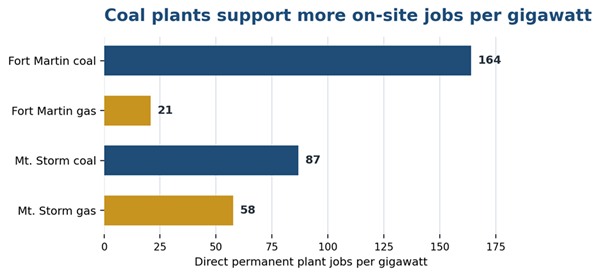
Figure 3. Approximate direct permanent jobs at the generating site, divided by nameplate capacity. Construction and indirect supply-chain employment are excluded.
Gas generation has its own supply chain, and a fair analysis has to count it. FirstEnergy’s economic-impact presentation projects nearly 2,200 direct and indirect ongoing jobs associated with the Fort Martin project and approximately $85.9 million in annual state and local taxes. The company has said hundreds of those jobs would arise in West Virginia’s gas industry. The estimate is company-sponsored, includes effects well beyond the 25 people at the generating station and depends on the plant buying incremental West Virginia gas rather than displacing other buyers or relying on production that would have occurred anyway. It is a real potential benefit, but it is not directly comparable to a plant payroll.
Coal also extends well beyond the gate. A 2026 West Virginia University report commissioned by the West Virginia Coal Association estimated that coal mining and coal-fired generation together supported approximately $21 billion in state economic activity, 36,249 jobs and about $1.3 billion in selected state and local taxes in 2024. The generation portion alone was estimated at $4.6 billion in activity, 5,649 jobs, $615.2 million in employee compensation and $315.1 million in state and local taxes. Because the report was commissioned by the industry and uses economic multipliers, those figures should be treated as an estimate of supported activity rather than a count of people standing inside power plants. They nevertheless identify the economic channels that disappear when coal units lose sustained generation: fuel purchases, mining payrolls, rail and truck movements, maintenance outages, engineering work, vendors and household spending by those workers.
Fort Martin, Harrison, Mt. Storm, Longview and Pleasants together recently generated about 27.8 million megawatt-hours, close to two-thirds of the 43 million megawatt-hours of coal-fired generation used in the WVU statewide study. It would be wrong to claim that two proposed gas plants automatically erase two-thirds of the sector, because Longview is being preserved, Harrison remains active, Pleasants has already been running at a low rate and both utilities say their gas projects are additions. It would be equally wrong to evaluate a loss of coal dispatch as nothing more than a fuel switch inside the same fence. Every sustained decline in coal output reduces tons purchased and work performed somewhere in that chain, often before a formal retirement announcement appears.
The employment balance therefore turns on whether the buildout is additive. If the gas plants serve genuinely new load while Fort Martin and Mt. Storm continue to run at roughly their present rates, West Virginia can retain coal employment and gain construction, gas-production and gas-plant work. If the gas units reduce coal dispatch and accelerate retirement, a smaller on-site gas workforce replaces a larger coal payroll at Fort Martin, while the outcome at Mt. Storm depends on whether the promised 150 gas jobs materialize and how much coal-supply activity is lost. Regulators cannot resolve that question with nameplate capacity or ribbon-cutting job totals. They need annual generation, fuel-purchase and employment forecasts for both fuels under the same demand assumptions.
MARL’s purpose and West Virginia’s share of the bill
The proposed MidAtlantic Resiliency Link adds another reason to examine the projects as a regional system rather than as isolated plants. MARL is planned as an approximately 107.5-mile, 500-kilovolt line from Dunkard Township, Pennsylvania, near the West Virginia border, to a connection near Gore, Virginia. It would be capable of carrying power in either direction and would cross northern and eastern West Virginia on the way toward the Virginia load centers.
A map-based estimate using the project’s published generalized alignment places the Fort Martin and Longview sites within roughly a mile of the proposed corridor. Harrison and Mt. Storm are each roughly 27 to 30 miles from it, while Pleasants is more than 70 miles away. Those are approximate straight-line distances to a generalized route, not surveyed right-of-way measurements, and the final alignment can change during permitting.
Distance alone does not determine electrical access. Fort Martin and Longview already connect at high voltage near the northern end of the corridor. Harrison and Mt. Storm are connected through the broader 500-kilovolt network. MARL is not proposed as a dedicated outlet for any one generator, and it would not automatically take power from the new Mt. Storm plants. A direct connection or material change in injection would require the appropriate PJM interconnection studies, protection work and possibly additional network upgrades.
The line could still increase the market value of generation in northern and eastern West Virginia by improving the ability to move power toward Maryland and Virginia. That does not guarantee that Mt. Storm electricity would flow over MARL in every hour. Power follows the conditions of the network, and PJM dispatch changes with congestion, outages and demand. The proper conclusion is that MARL may make eastward sales easier at the regional level, not that it has been designed as a private extension cord for Mt. Storm, Fort Martin or Longview.
The economic purpose of the project is less ambiguous than its hourly power flow. FirstEnergy’s federal filing and PJM planning materials identify unprecedented load growth in Northern Virginia, led by data centers, as the principal reason for the transmission solution that became MARL. The line is not electrically exclusive to those facilities, and NextEra says it will improve regional reliability, allow two-way flows and produce construction and property-tax benefits in Pennsylvania, West Virginia, Maryland and Virginia. Those claims deserve consideration. They do not change the fact that Northern Virginia load is the dominant cause of the project.
The cost has also changed dramatically. The NextEra portion of MARL was initially estimated at approximately $441 million and is now approximately $960 million after design development, vendor quotes, land estimates and contingency were updated. PJM’s February 2026 white paper attributes about $404 million of the increase to the 30 percent design and related revisions. The Institute for Energy Economics and Financial Analysis, a research group that opposes shifting data-center infrastructure costs to ordinary customers, estimates that West Virginia ratepayers could pay approximately $572 million over 40 years for the NextEra portion after financing, construction work in progress and related revenue requirements. That is an advocate’s estimate rather than a commission finding, but it is the clearest public attempt to trace the state’s lifetime burden under the regional allocation formula.
The formula is the problem. PJM assigns a portion of regional transmission costs to utility zones according to its approved planning rules, not according to state borders or a simple invoice sent to the customer that caused the project. West Virginia customers in the APS and AEP zones can therefore pay even when the principal new load sits in Northern Virginia. The charge is definite once approved and placed in transmission rates. The claimed West Virginia export benefit is contingent: MARL may reduce congestion and improve access, but no public analysis reviewed for this article guarantees additional dispatch, additional capacity revenue or a customer credit to Fort Martin, Harrison, Longview or Mt. Storm equal to the amount West Virginians will pay.
It is therefore imprecise to say that MARL will serve only Northern Virginia. The line will be part of a regional, bidirectional network and may benefit West Virginia generators and local reliability. It is fair to say that its principal economic purpose is to serve Northern Virginia’s data-center-driven load growth and that the current cost allocation can place an inordinate share on West Virginians without demonstrating an equivalent value to them. The burden includes more than the nominal construction price. Transmission revenue requirements can include financing during construction, return on equity, depreciation, operation and maintenance, property taxes and income taxes over decades.
This distinction should be part of the cost review. Virginia has already created a separate class for customers demanding 25 megawatts or more and imposed minimum payment obligations intended to reduce the chance that ordinary customers finance infrastructure for projects that do not materialize. West Virginia should insist on the same principle at the regional level: data centers and other large loads that create the need should sign binding contracts, carry cancellation risk and pay the transmission costs attributable to them. If MARL produces measurable congestion savings or export value for West Virginia, those benefits should be calculated and credited in the same docket. The state should not be asked to accept a theoretical regional benefit against a fixed multidecade bill.
A cost-benefit ledger for the people of West Virginia
A complete economic review cannot honestly collapse this buildout into one precise net-present-value figure. The Fort Martin gas plant has a filed cost, Mt. Storm does not. Longview’s purchase price is undisclosed, Pleasants is in bankruptcy, the TerraSpark and Longview gas projects have no committed construction schedule, and MARL’s final route and cost allocation remain subject to regulatory decisions. Job estimates come from different studies with different definitions, while environmental, health, land and cleanup effects have not been monetized on a common basis. Pretending that those gaps can be solved with a single total would create false precision.
The available numbers are still sufficient to construct a disciplined ledger. It separates private investment from customer obligations, temporary work from permanent jobs, and West Virginia benefits from regional benefits that may accrue mainly elsewhere.
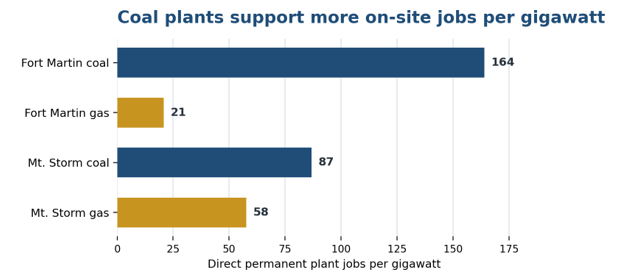
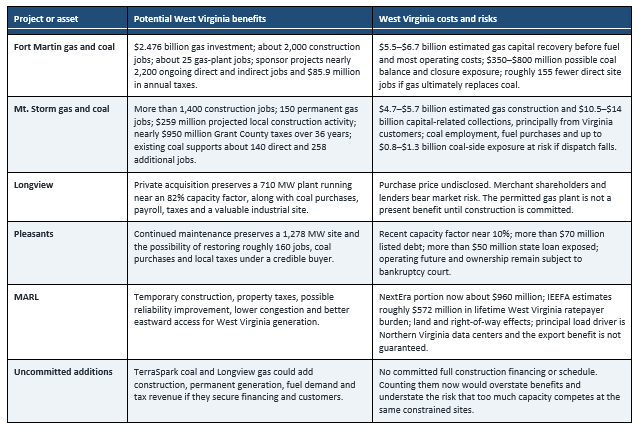
Table 2. Quantified and structural effects identifiable from the current public record. Sponsor projections and independent estimates are labeled because they are not commission findings.
The largest near-term benefit is construction. Fort Martin and Mt. Storm together promise more than 3,400 construction jobs and between approximately $7.2 billion and $8.2 billion in plant investment using the filed Fort Martin cost and the estimate developed here for Mt. Storm. Some of that money would flow to specialized turbine manufacturers and contractors outside West Virginia, but wages, site work, lodging, materials and local purchases would create a substantial temporary stimulus. Mt. Storm’s sponsor projects $259 million in Grant and Tucker County economic activity during construction, nearly $950 million in Grant County taxes over the first 36 years and 150 permanent jobs. FirstEnergy’s sponsored analysis projects nearly 2,200 ongoing direct and indirect jobs and $85.9 million in annual state and local taxes across the plant and gas supply chain.
Those benefits must be set against who finances them. West Virginia customers would be responsible for the regulated Fort Martin project if the Public Service Commission grants the requested recovery, including construction financing before the plant operates and prudent abandonment costs if it fails. The article’s planning estimate is $5.5 billion to $6.7 billion in capital-related customer collections over the plant’s life, excluding fuel and most operating costs, plus a potential $350 million to $800 million of remaining Fort Martin and closure exposure if the coal plant retires early. The proposed Mt. Storm gas plant would primarily be financed by Dominion’s Virginia customers, which makes the project more favorable from a narrow West Virginia fiscal perspective: West Virginia could receive construction, payroll, fuel-production and property-tax benefits while much of the regulated generation bill falls outside the state. That advantage weakens if the new unit displaces the existing Mt. Storm coal station and its coal supply chain.
MARL reverses that pattern. The principal demand is in Northern Virginia, but West Virginia transmission customers can be assigned a multidecade share. IEEFA’s current estimate of approximately $572 million for the state’s burden on the NextEra portion is not directly comparable to the gas plants’ construction costs because it is a lifetime revenue-requirement estimate and because West Virginia may receive some reliability, property-tax and export benefits. It is nevertheless a real opportunity cost. Money collected on electric bills is money households cannot spend at local businesses and money manufacturers cannot use for payroll, equipment or expansion. A benefit credited to the region is not automatically a benefit equal to the charge imposed on West Virginia families.
Longview offers the cleanest positive case. AEP’s merchant subsidiary is buying a high-utilization coal plant with private capital, preserving a 710-megawatt source of generation, coal purchases, payroll and taxes without announcing a regulated charge to Appalachian Power customers. The purchase price is private and undisclosed, so the state cannot yet calculate the buyer’s return, but the risk allocation is appropriate: investors receive energy and capacity revenue and investors bear the loss. The permitted 1,200-megawatt gas plant at the site should not be counted as a benefit until AEP commits capital, a schedule and an ownership structure.
Pleasants is the clearest current negative. The plant may preserve approximately 160 jobs and regain coal purchases if a credible buyer restores generation, but its recent capacity factor is near 10 percent, more than $50 million of a state economic-development loan is exposed in bankruptcy and the promised hydrogen and graphite business did not reach commercial operation. Continued maintenance during Chapter 11 preserves options; it does not repay taxpayers or establish a viable operating future. No additional public capital should be committed without a court-approved ownership plan, verified technology, firm customers and private money at risk ahead of the state.
Environmental and health costs belong in the ledger even when they cannot yet be stated as a reliable project-specific dollar amount. Continued coal generation preserves jobs and fuel security but also continues mine impacts, ash obligations and air emissions. New gas generation reduces some conventional emissions per megawatt-hour but creates pipeline, methane-leakage and long-term carbon exposure, along with fuel-price risk for customers. MARL creates right-of-way, property-value and land-use effects while potentially reducing congestion and improving reliability. A regulator that counts only tax revenue and construction payroll is not performing a full cost-benefit analysis; it is selecting the benefits and leaving the costs unmeasured.
Four economic outcomes
The best outcome is genuine addition. Data centers, factories and other large customers actually connect, sign contracts long enough to cover the facilities built for them, and pay the generation and transmission costs they cause. Fort Martin, Harrison and Mt. Storm continue to generate at economically defensible levels, Longview remains a high-performing merchant plant, Pleasants finds a private buyer, and West Virginia gas production supplies the new units. In that case, the state retains most of its coal employment while adding construction, gas, plant and tax revenue. Even then, ordinary customers need protection from cost overruns and speculative load because the gross benefit can coexist with higher household bills.
The second outcome is substitution concealed by the language of addition. The new gas plants enter service, coal dispatch falls and Fort Martin or Mt. Storm retires while unrecovered balances and cleanup costs remain. At Fort Martin, approximately 25 gas-plant jobs would replace about 180 coal-plant jobs at nearly the same capacity, a direct on-site loss of roughly 155 before coal-supply effects. Customers could pay the new gas revenue requirement and the remaining coal costs at the same time. This outcome is likely negative for West Virginia workers and ratepayers unless the gas project produces unusually large, verifiable in-state fuel and tax benefits and materially lowers the cost of electricity.
The third outcome is an export buildout. Mt. Storm, Longview and perhaps other West Virginia plants use the regional grid to serve load concentrated in Virginia, while the state gains production, fuel, payroll and property taxes. Exporting energy can be good business, and it does not matter physically which electron reaches which data center. The distribution of cost does matter. If Virginia customers pay for Mt. Storm generation while West Virginia customers are assigned a large share of MARL, the state could gain on the plant and lose on the wire. The net result is favorable only if the West Virginia tax, wage, fuel and congestion benefits exceed the transmission burden and the lost economic activity from any displaced coal generation.
The worst outcome is demand shortfall. Projected data centers are delayed, downsized or canceled after utilities have begun construction. The gas plants and MARL are underused, capacity prices fall as new supply arrives, and the coal units still lose value because utilities have committed to the new assets. Under the requested Fort Martin protections, customers could be asked to pay for cancellation, abandonment or stranded costs even without receiving the expected electricity. Pleasants has already demonstrated what happens when promised industrial demand and technology do not produce operating revenue, except that the regulated gas and transmission projects could place far more of the loss on captive customers.
The present verdict
On the public record available today, the buildout has not been shown to produce a net economic benefit for the people of West Virginia as a whole. It offers large and credible local benefits—construction work, gas demand, tax revenue, preservation of Longview and the possibility of more generation—but those gains are unevenly distributed and partly based on sponsor studies. The burdens are also large: $5.5 billion to $6.7 billion of estimated Fort Martin gas capital recovery before fuel and operating costs, possible recovery of old coal balances, more than $50 million of state exposure at Pleasants and an advocate’s estimate of approximately $572 million in West Virginia MARL charges. The potential loss of coal payroll and supply-chain activity is not included in those dollar totals, which makes the present comparison more favorable to the buildout than a complete accounting may prove.
The most favorable components are those where outside customers or private investors carry the risk while West Virginia receives production and tax benefits. That describes the Longview acquisition and could describe Mt. Storm if Virginia customers finance the gas plant without the project materially reducing the existing coal station. The least favorable components are those where ordinary West Virginians pay before demand is firm. That describes the requested Fort Martin construction recovery, the public exposure at Pleasants and the current MARL allocation unless it is changed or offset by a demonstrated state benefit.
The buildout can become a net benefit, but only if approvals change the allocation of risk. Large-load customers should provide security and minimum payments sufficient to cover generation and transmission built for them. Utilities should face hard cost caps, and shareholders should absorb a stated portion of overruns, cancellation costs and any remaining coal balance if new gas materially reduces coal dispatch below the forecast used for approval. All energy and capacity revenue from regulated plants should be transparently credited to customers. MARL costs attributable to Northern Virginia data centers should follow those loads, and any claimed West Virginia export benefit should be quantified rather than assumed. Pleasants should receive no additional unsecured public subsidy, and job claims should be reported as direct permanent jobs, temporary job-years and indirect employment in separate categories.
Those conditions do not favor coal over gas or gas over coal. They favor West Virginians over financial structures that privatize the return and socialize the downside. If the projects are truly additions required by new customers, the companies should be able to prove the demand, identify the payer and accept consequences if their forecasts fail. If they will not, the safer economic conclusion is that the state is being asked to provide land, labor, fuel and transmission while families and existing employers assume risks created principally for someone else’s growth.
The questions regulators have not yet answered
The central concern is not that gas and coal cannot coexist. They can, and in a tightening capacity market there are plausible reliability reasons to keep diverse fuel sources available. The concern is that the approval process can treat the new gas plant as an addition when the utility seeks construction authority, then treat the coal plant as stranded when actual dispatch or later planning makes retirement attractive. Customers would have financed the addition and could then be charged for the consequences of replacement.
FirstEnergy’s earlier replacement statement gives the West Virginia commission a direct reason to examine that sequence. The company should be required to reconcile its chief executive’s 2025 description with the current claim of continued coal operation. It should file an annual dispatch forecast for Fort Martin, Harrison and the new gas station under high and low gas prices, high and low coal prices, delayed data-center projects and different PJM capacity-price assumptions. It should identify the remaining book value and expected retirement, demolition and ash costs for both coal stations. It should also show what portion of the gas plant is needed for existing customers and what portion is driven by speculative or contractually committed new load.
Dominion should face the same standard at Mt. Storm. A statement that the gas plant will have no impact on the coal plant cannot be squared with a planning record that showed coal use falling to a 2 percent capacity factor without a detailed explanation. The Virginia commission should require one model that dispatches the proposed gas units and the coal units together, accounts for the proposed TerraSpark plant only as a clearly labeled sensitivity, and includes MARL and other transmission assumptions. It should disclose the coal plant’s current balance, environmental options and closure liabilities before deciding how much new gas investment customers should support.
Both commissions should set firm construction-cost limits and specify in advance how overruns will be divided between customers and shareholders. They should require large new loads to sign contracts that protect other customers if projects are delayed or canceled. They should also determine what happens if the new gas plant causes the coal station to run substantially less than forecast. If the utility earns a return on the gas investment while the gas plant accelerates the economic retirement of an older unit, regulators should consider whether shareholders, rather than customers alone, should bear part of the remaining coal balance.
The merchant plants provide the comparison and complete the pattern. AEP’s competitive business bought Longview because it believes a high-performing coal plant and a permitted gas site can earn their way in the market. Pleasants entered bankruptcy because its technology and financing plan did not. Those outcomes are harsh, but they reveal the cost of bad assumptions. Regulated customers deserve protection at least as demanding as the discipline imposed on merchant investors.
West Virginia may need more generation. PJM’s capacity shortage, rising industrial demand and data-center development all support a serious examination of new power plants. They do not justify approving each project in isolation or accepting “addition” as a permanent description of what may later become replacement. At Fort Martin and Mt. Storm, the issue is not whether the coal units will still be operating on the day the gas plants open. The issue is how much they will run, how long they will remain useful, what costs will remain when they close, and who will pay if the assumptions used to approve the gas plants prove wrong.
I do not believe these events are coincidental in the sense that they are meaningless or unrelated. They arise from the same collision of rising demand forecasts, scarce transmission access, valuable old plant sites, renewed political support for coal and a regulatory system that can place investment risk on very different groups of people. The public record does not show a conspiracy to strand coal plants. It does show a financial structure that could reward new construction while protecting recovery of old investment, and it shows statements that have shifted as projects moved from investor presentations to regulatory filings. That is enough to require more than assurances. Before customers are committed to tens of billions of dollars in lifetime costs, regulators should make the utilities answer the replacement question in numbers.
Methodology and source note
The lifetime recovery ranges in this article are planning estimates, not company forecasts or findings by a utility commission. The Fort Martin gas estimate begins with FirstEnergy’s filed $2.5 billion construction cost, 50 percent debt and 50 percent equity structure, 9.8 percent allowed return on equity and a 30- to 35-year recovery period. The Mt. Storm gas estimate applies a range around the current Fort Martin cost per kilowatt because Dominion has not yet filed a complete public cost case. Actual recovery will depend on approved construction cost, debt rates, depreciation, taxes, financing timing and commission treatment.
Coal-side estimates combine publicly reported plant balances with broad allowances for additional capital, demolition, ash management and site closure. Mt. Storm’s June 2022 balance of approximately $515 million is public; current balances for Mt. Storm and Fort Martin were not available in one complete public filing reviewed for this article. The ranges are intended to identify the possible order of magnitude and should be replaced with audited utility figures during regulatory review.
The capacity-payment table applies the 2028–29 PJM clearing price of $325 per megawatt-day to 80 percent of each plant’s stated nameplate capacity. The 80 percent factor is an illustration, not a unit-specific PJM accreditation. The resulting figures are gross potential capacity revenue before ownership shares, replacement transactions, penalties, rate credits or other settlements. They should not be treated as a forecast that a proposed plant will be completed, qualify, offer, clear or receive the same future price.
Employment figures are not fully comparable. Plant fact sheets generally report direct workers at a site; project announcements may report projected permanent jobs; economic-impact studies add supplier and household-spending effects using multipliers. Construction employment is temporary and may be reported as workers, positions or job-years. This article therefore reports the categories separately and does not add temporary construction positions to ongoing employment.
Principal sources include FirstEnergy’s February 13, 2026 filing summary in West Virginia Public Service Commission Docket 26-0108-E-CN; FirstEnergy’s Maidsville announcement, plant fact sheets, economic-impact material and 2025 investor statements; Dominion’s Mt. Storm announcement; public testimony in Virginia cases PUR-2025-00058 and PUR-2023-00005; the Virginia State Corporation Commission’s November 25, 2025 biennial-review order; AEP’s statement on the Longview acquisition; the Omnis Pleasants bankruptcy petition and related public reporting; U.S. Department of Energy and West Virginia announcements concerning TerraSpark; Clearway’s Mt. Storm wind announcement; PJM’s current Capacity Market Manual and 2028–29 auction report; the West Virginia Public Service Commission’s capacity-market investigation order; NextEra’s MARL project description; PJM and IEEFA material on MARL cost and allocation; the 2026 West Virginia coal economic-impact study; recent EIA-based generation data summarized by GridInfo; and the Week 30, 2026 issue of Coal Currents.
Selected public records
1. FirstEnergy, “Mon Power and Potomac Edison WV CPCN and Siting Certificate Filing,” February 13, 2026: https://s27.q4cdn.com/655807321/files/doc_downloads/2026/02/13/MonPower-Filing_2-13-26_Final.pdf
2. FirstEnergy, “Mon Power and Potomac Edison Select Maidsville, West Virginia, Site for New Natural Gas Power Plant”: https://www.firstenergycorp.com/newsroom/news_articles/mon-power-potomac-edison-select-site-for-natural-gas-power-plant.html
3. West Virginia Public Broadcasting, “First Energy CEO Says Gas Will Replace Mon Power Coal Plants,” February 28, 2025: https://wvpublic.org/story/energy-environment/first-energy-ceo-says-gas-will-replace-mon-power-coal-plants/
4. Office of the Governor of West Virginia, “Governor Morrisey Announces 2.6 GW Natural Gas Power Plant in Grant County, Existing Coal Station Remains Operational,” July 28, 2026: https://governor.wv.gov/article/governor-morrisey-announces-26-gw-natural-gas-power-plant-grant-county-existing-coal
5. Virginia State Corporation Commission public testimony, Case PUR-2025-00058: https://www.synapse-energy.com/sites/default/files/Glick%20Direct%20%28Public%29_BaseandFuel%2025-056.pdf
6. Virginia State Corporation Commission public testimony, Case PUR-2023-00005: https://www.synapse-energy.com/sites/default/files/PUR-2023-00005%20-%20Glick%20Direct%20%28Public%29%2023-024.pdf
7. WV MetroNews, “AEP buys Maidsville coal-fired plant, acquires permits for natural gas expansion on the site,” August 1, 2026: https://wvmetronews.com/2026/08/01/aep-buys-maidsville-coal-fired-plant-acquires-permits-for-natural-gas-expansion-on-the-site/
8. West Virginia Public Broadcasting, “Pleasants Power Station Owner Files For Bankruptcy,” July 28, 2026: https://wvpublic.org/story/energy-environment/pleasants-power-station-owner-files-for-bankruptcy/
9. NextEra Energy Transmission, MidAtlantic Resiliency Link project description: https://www.nexteraenergytransmission.com/midatlantic-resiliency-link.html
10. U.S. Department of Energy, “Energy Department to Invest $350 Million to Build, Modernize, and Restart Coal Plants,” June 4, 2026: https://www.energy.gov/articles/energy-department-invest-350-million-build-modernize-and-restart-coal-plants
11. BankruptcyData, “Court Approves Interim Cash Collateral Use and First Day Relief,” July 29, 2026: https://widearea-exxiona-bankruptcydata-com-public-site.linode-services.bankruptcydata.com/article/from-the-courtroom-omnis-pleasants-llc-a-court-approves-interim-cash-collateral-use-and-first-day-relief-over-equity-ownersa-objection-as-debtor-details-alleged-wveda-financing-fraud
12. PJM Interconnection, “2028/2029 Base Residual Auction Report,” July 14, 2026: https://www.pjm.com/-/media/DotCom/markets-ops/rpm/rpm-auction-info/2028-2029/2028-2029-bra-results-report.pdf
13. PJM Interconnection, Manual 18, “PJM Capacity Market,” Revision 62, effective December 17, 2025: https://www.pjm.com/-/media/DotCom/documents/manuals/m18.pdf
14. Monitoring Analytics, “2025 State of the Market Report for PJM,” March 2026: https://www.monitoringanalytics.com/reports/PJM_State_of_the_Market/2025/2025-som-pjm-vol1.pdf
15. Public Service Commission of West Virginia, General Order No. 267.6, investigation of West Virginia utility participation in the PJM capacity market, 2025: https://www.psc.state.wv.us/scripts/orders/ViewDocument.cfm?CaseActivityID=642098&Source=Docket
16. FirstEnergy, “New Generation Facilities Proposed by FirstEnergy to Spark Job Growth and Economic Opportunity in West Virginia”: https://www.firstenergycorp.com/newsroom/news_articles/new-generation-facilities-proposed-by-fe-to-spark-job-growth-econ-opp-in-wv.html
17. FirstEnergy, “Fort Martin Power Station Fact Sheet”: https://www.firstenergycorp.com/content/dam/corporate/generationmap/files/FE-Ft%20Martin%20Fact%20Sheet.pdf
18. West Virginia University Bureau of Business and Economic Research, “The Economic Impact of Coal and Coal-Fired Power Generation in West Virginia,” 2026: https://researchrepository.wvu.edu/cgi/viewcontent.cgi?article=1361&context=bureau_be
19. Institute for Energy Economics and Financial Analysis, “West Virginia costs for transmission infrastructure to power data centers soar,” March 24, 2026: https://ieefa.org/resources/west-virginia-costs-transmission-infrastructure-power-data-centers-soar
20. PJM Interconnection, “PJM Board Whitepaper,” February 2026, MARL scope and cost update: https://www.pjm.com/-/media/DotCom/committees-groups/committees/teac/2026/20260203/20260203-pjm-board-whitepaper-february-2026.pdf
21. West Virginia University Bureau of Business and Economic Research, “The Economic Impact of the Mount Storm Power Station,” 2023: https://researchrepository.wvu.edu/cgi/viewcontent.cgi?article=1326&context=bureau_be
22. The Dominion Post, “A look at FirstEnergy’s planned gas-fired plant and Fort Martin,” June 3, 2026: https://www.dominionpost.com/2026/06/03/a-look-at-firstenergys-planned-gas-fired-plant-and-fort-martin/